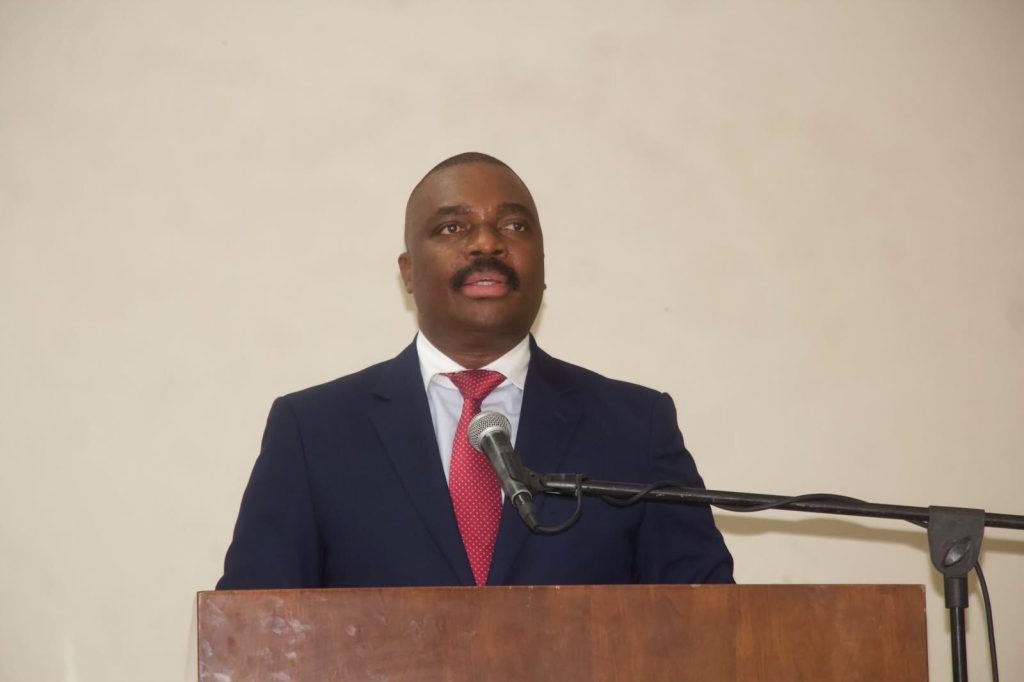
The Secretary of State for Science and Higher Education, Edson da Graça Francisco Macuácua, delivered the opening address of the 11th International Congress on Environmental and Territorial Sustainability on 6 October 2026 at Joaquim Chissano University in Maputo — the first edition of the congress to be held on the African continent.
The full text of the address is published below.
Greetings
It is with immense honour and a deep sense of State responsibility that I take the floor at this opening session of the 11th International Congress on Environmental and Territorial Sustainability.
On behalf of the Government, let me begin by warmly saluting the strategic partnership between Joaquim Chissano University, Save University and the Foundation for Environmental Sustainability — a clear example of how joining the efforts of academia and civil society can create dialogue platforms crucial to our country’s future.
I welcome all congress participants from every corner of the world, and trust that you will have a pleasant stay and enjoy Mozambique’s warm hospitality.
I also wish to extend a special greeting to the national and international speakers and moderators who enrich this Congress by sharing their scientific research. Your willingness to share knowledge, lead debates and guide scientific reflection is the engine that turns this Congress into a genuine incubator of innovative ideas.
This is a historic congress of great scientific, political and diplomatic importance, taking place for the first time on the African continent.
To speak of environmental and territorial sustainability today is not a mere exercise in academic rhetoric, but a matter of survival and sovereignty. The impacts of climate change, pressure on natural resources and the need to plan the territory fairly and safely place this debate at the centre of the national and global political agenda.
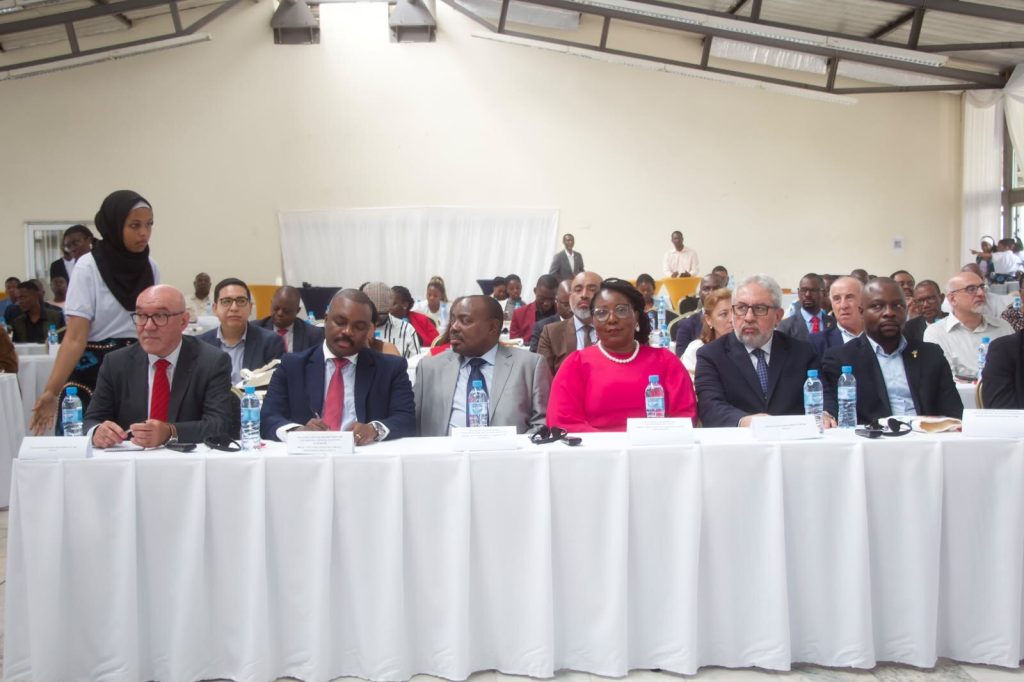
Why it matters that Mozambique hosts this Congress
Geographical front line: Mozambique is not merely the host of this event; our country is on the global front line of climate impacts, owing to its geographical location and configuration.
Demonstrated resilience: hosting this Congress demonstrates our resilience and the Government’s unwavering commitment to leading the transition to greener development in the SADC region, on the African continent and worldwide.
A platform for dialogue: it positions our higher education institutions as poles attracting international critical mass, showing that solutions for global sustainability are also designed here.
Why an international scientific congress on this theme matters
Evidence-based decisions: sustainability cannot be achieved on the basis of empiricism alone. We need science to inform public policy on territorial planning, biodiversity conservation and disaster mitigation.
Frontier exchange: this Congress works as a platform for validating data, where global theories are tested and adapted to the practical realities of sustainable territorial planning.
The global and local situation
The global reality: we are witnessing a triple planetary crisis — accelerating climate change, severe biodiversity loss and widespread pollution. The planet demands a radical change in models of production and consumption.
The local reality: we feel these effects first-hand through the extreme cyclicity of weather events, such as devastating tropical cyclones, severe floods and prolonged droughts. The local challenge is urgent: to protect our coastal and rural communities, ensure food security, and manage natural resources without compromising the future of coming generations.
Producing, sharing and applying scientific research
Useful knowledge: science must not stay locked away in university libraries. Research only gains real value when it is applied to solving concrete problems in our districts and provinces.
Practical globalism: the challenges are global, such as the warming of the planet, but effective responses are profoundly local.
The importance of environmental and territorial sustainability
The theme of this Congress is not merely a subject for academic debate; it is the greatest geopolitical, social and economic challenge of our century. To speak of environmental and territorial sustainability is to speak of our own survival and of the quality of life we leave to coming generations.
Territory is not a static backdrop. It is a living, dynamic organism where biodiversity, human communities, the economy and culture intersect. Sustainable territorial management is therefore the master key to ensuring that economic development does not exhaust natural resources but, on the contrary, protects and enhances them.
The challenges of our time
We cannot ignore the urgency of the challenges we face. We are witnessing an unprecedented acceleration of climate change, whose impacts translate into extreme events, alarming biodiversity loss and the scarcity of vital resources such as water.
At territorial level, we face complex pressures:
Desertification and the human abandonment of inland areas, which weaken the social fabric and increase the risk of catastrophic forest fires.
Disorderly urban pressure in coastal areas, which threatens sensitive ecosystems and exposes populations to rising sea levels.
The need for an energy transition, which demands new forms of land occupation and use, reconciling clean energy production with the preservation of landscape and agriculture.
These challenges are global, but their consequences are felt locally, in every municipality, in every ecosystem and in the daily lives of our citizens.
The central role of science and research
Faced with so complex a reality, where do we find the answers? The answer is clear: in science, in scientific research and in higher education.
There will be no green transition and no territorial cohesion without well-founded knowledge. It is scientific research that provides the data to understand climate dynamics, that develops satellite monitoring technologies, that creates sustainable materials and that designs circular economic models.
Academia has the noble and urgent mission of producing useful knowledge that enables public policy grounded in scientific evidence. Science must be the compass that guides the legislator. The knowledge generated in your universities must translate into decrees, development strategies and robust, effective territorial planning.
Our expectations
Our expectations for this congress are high. We hope the debates will not be confined to sharing diagnoses, but will yield deliverables in the form of concrete proposals.
We therefore await the conclusions of this forum with great interest, convinced that your contributions will enrich the government policies under way.
We hope this event produces workable recommendations and solid bridges between science and governance.
With these words, and reaffirming the Government’s commitment to supporting science in the service of sustainable development, I officially declare open the 11th International Congress on Environmental and Territorial Sustainability.
My best wishes to you all for an excellent and productive Congress. Thank you very much.