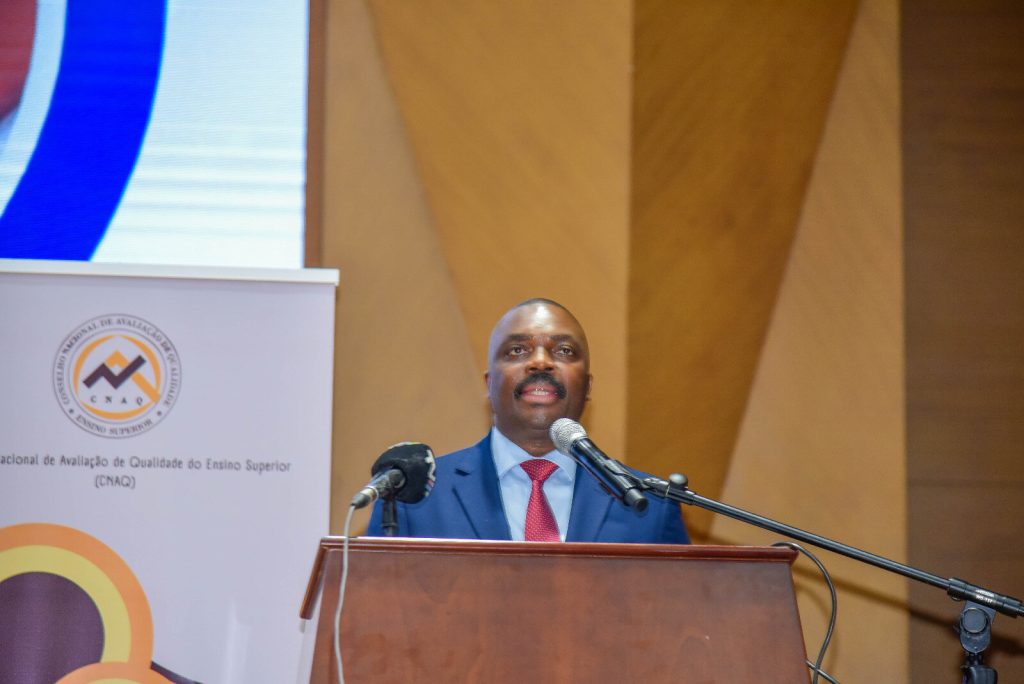
The Secretary of State for Science and Higher Education, Edson da Graça Francisco Macuácua, delivered the opening and closing addresses of the VIII Forum of Higher Education Institution Leaders, convened by the National Council for Quality Assessment in Higher Education (CNAQ) and closed on 9 October 2026 in Maputo.
The three-day forum debated the governance of higher education institutions with a focus on quality. The full texts of both addresses follow.
Opening address
First of all, I salute the organisation and holding of this forum of higher education leaders focused on quality, an initiative that reflects the urgency and the collective commitment to debating the future of our higher education ecosystem. This space for dialogue is proof that we share the same vision: that our country’s development passes, necessarily, through the classrooms, laboratories and management offices of our institutions.
I wish to express appreciation and recognition for the excellent work the National Council for Quality Assessment (CNAQ) has carried out. Quality assurance does not happen by chance; it demands rigour, oversight and monitoring. CNAQ has been the guarantor that academic and pedagogical standards are met, challenging our institutions to surpass themselves and to protect the greatest good we offer our students: formative excellence.
The central question before us today is clear and imperative: what should the governance of a quality-focused higher education institution look like?
For a long time, governing higher education was strictly associated with budget management, infrastructure administration and meeting bureaucratic requirements. Today, that is merely the minimum threshold. Modern governance of excellence demands far more. Quality-focused governance means, fundamentally, placing student success, the relevance of research and community impact at the centre of every policy and administrative decision.
Four pillars
First, a culture of self-assessment and transparency. Quality is not a seal obtained once and filed away in a drawer. It is a continuous process. Governing for quality means monitoring data rigorously, accepting failures honestly, and treating external accreditation not as an obligation but as a tool for continuous improvement.
Second, centrality of the student and of learning. A quality institution designs its governance around the needs of those who learn. This requires pedagogical modernisation, support for students’ mental health and well-being, and assurance that the skills acquired prepare them for the complex challenges of the labour market.
Third, valuing and building the capacity of teaching, technical and administrative staff. There is no quality teaching without motivated, qualified teachers, researchers and technical staff. Governance must create ecosystems that reward merit, stimulate pedagogical innovation and provide the conditions for producing science of global standard.
Fourth, sustainability and vision for the future. Managing with quality also means managing with financial, social and environmental responsibility. We must be able to anticipate scenarios, events and trends — such as artificial intelligence, globalisation and the ecological transition — adapting our curricula and management models before we become obsolete.
What quality in higher education means
Quality is not an abstract concept, nor a mere set of bureaucratic indicators. Defining quality in higher education means ensuring that the teaching and learning process transforms the student positively. It means having qualified, motivated teaching staff, modern and adequate infrastructure, up-to-date curricula and a culture of constant self-assessment. Quality is the capacity to respond to society’s real needs, delivering graduates who possess not merely a diploma but technical, critical and ethical competence.
This reflection takes us directly to the social and economic relevance of higher education. Higher education institutions cannot be islands of knowledge isolated from their context. Higher education is the engine of social mobility par excellence; economically, it dictates our global competitiveness.
To refuse quality in higher education is to choose planned backwardness, the fastest route to global irrelevance and to the structural failure of society.

The employability paradox
Today we face one of the greatest and most complex paradoxes of our era. Never have we had so many qualified young people entering the labour market and yet never has the employability challenge been so demanding and uncertain.
The question echoing in classrooms and at family tables is no longer merely “what will you study”, but “will what you study guarantee you a future”. This is a reality universities cannot ignore. We cannot go on being merely temples for transmitting static knowledge. The twenty-first century university must be a living, agile and unbreakable bridge to the real world.
Our focus must change urgently along three fundamental axes:
First, from theory to agility. The labour market no longer seeks only diplomas; it seeks competence. We must teach students to learn, to unlearn and to relearn. Technical knowledge is the foundation, but adaptability, critical thinking and emotional intelligence are the true passport to employment.
Second, from the classroom to the ecosystem. Universities and companies cannot go on living in parallel, isolated worlds. We must bring the market inside our campuses through integrated internships, joint innovation laboratories and practical mentoring from the first year. If the market changes at the speed of light, our curricula cannot take years to adapt.
Third, from employment to entrepreneurship. Employability does not mean merely preparing someone to send a CV and wait for a vacancy. It means preparing every student to create their own opportunities. We must cultivate the entrepreneurial spirit, so that our graduates are not merely job applicants but generators of new solutions and new economies.
We are aware that quality and innovation demand resources. That is why public-private partnerships take on crucial strategic importance in securing the sustainability and quality of teaching. The State must not walk alone. Attracting private investment, jointly financing research centres, creating corporate chairs and sharing technological infrastructure are obligatory paths to ensuring that our higher education is sustainable over time and modern in delivery.
Course accreditation
One of the contested matters in our ecosystem is course accreditation. The accreditation process is often viewed with reservations, seen as burdensome, a purely bureaucratic requirement, an exhaustive filling-in of reports or an intrusive audit. But we urgently need to change this perspective. Accreditation is not an obstacle; it is the mirror of our excellence and the greatest guarantee of our institutions’ sustainability.
First, institutional credibility and public trust. When an institution submits its courses for accreditation and is approved, it sends a clear signal to society, to families and to the labour market. That signal says: “our diplomas have real value”. An accredited course protects students’ investment and validates the efforts of the teaching staff. Without it, we risk issuing qualifications the market will reject.
Second, a culture of continuous improvement. Accreditation is not a static photograph; it is a dynamic process. It forces us to look inward, to assess our infrastructure, to update our curricular frameworks and to qualify our teaching staff. It points out where we are failing and how we can improve. Seeing accreditation as a management tool is what distinguishes the institutions that stagnate from those that lead.
Third, mobility and internationalisation. We live in the age of globalisation. Our graduates do not compete only locally; they compete globally. How can we expect our students’ diplomas to be recognised abroad, or our institutions to enter international partnerships, if our courses do not meet the minimum quality standards validated by the regulator? Accreditation is the passport to academic and scientific mobility.
I therefore invite all higher education leaders to approach this process not as an external imposition but as an internal commitment to excellence. Let us be partners on this journey. Let us demonstrate that our higher education is robust, serious, transparent and, above all, focused on quality.
Artificial intelligence
We are living through the surge of artificial intelligence. This is not a mere technological change; it is a cognitive revolution that reconfigures how knowledge is produced, transmitted and validated. In the face of this, our principal mission remains unaltered, but our context has changed drastically: how can we ensure teaching quality in an ecosystem where the machine learns and the human must relearn how to think?
The crisis of academic integrity. The first and most immediate challenge lies in assessment. In a world where AI tools generate essays, solve complex equations and write code in seconds, our traditional assessment methods become obsolete. If we assess only the final product, we risk certifying algorithms rather than human competence.
Exclusion and the digital divide. We cannot speak of artificial intelligence without speaking of equity. Access to these advanced technologies and to high-speed connectivity is still unequal in our country. The quality challenge is also one of inclusion: we cannot allow artificial intelligence to create a new divide between hyper-connected students and marginalised ones.
Updating the teaching staff. Our teaching staff face unprecedented pressure. Our teachers are required to be not merely transmitters of data — a function the machine performs effectively — but mentors of critical thinking. Yet many of our academics still lack digital literacy and training to integrate these tools into their methodologies.
Artificial intelligence should not, however, be seen as a threat to higher education, but as the greatest opportunity for democratisation and for raising quality that we have ever had in our hands.
Hyper-personalised learning. It allows us to monitor each student’s progress in real time. It identifies learning gaps before an examination even takes place and generates personalised pathways. This means reducing retention and drop-out rates, raising the standard of academic success.
Efficiency and focus on the essential. By automating administrative and routine marking tasks, it frees up teachers’ time. That time should be reinvested in what the machine cannot replicate: scientific research, university outreach, ethical debate and humane tutoring.
Research of global impact. These tools accelerate the analysis of large volumes of data. Our institutions can use this power to accelerate research in vital areas such as precision agriculture, climate change, resource management and public health.
Quality assurance in the age of artificial intelligence will not be achieved by banning it. Trying to ban it from universities is like trying to forbid electricity from entering classrooms in the last century. The way forward is intelligent regulation, curricular innovation and pedagogical boldness.
As leaders, your role is to lead this transition. It is urgent that each institution design its own institutional policies for the ethical use of artificial intelligence. It is imperative that we adapt our curricula to focus on the competences the machine does not have: creativity, emotional intelligence, leadership and ethics.
The Government continues to invest in creating infrastructure and promoting sharing networks, but transformation happens inside each university campus, in each classroom, in each laboratory.
Let us embrace the future certain that the best intelligence we can cultivate in our institutions will always be human intelligence.
Quality-focused governance of higher education is not a destination: it is a continuous journey that demands courage to change, rigour in management and an unshakeable passion for knowledge. Ensuring quality in higher education is not a choice: it is an ethical and legal duty.
I wish you all a productive forum, and hope that concrete proposals emerge for strengthening quality, relevance and employability. Thank you very much.
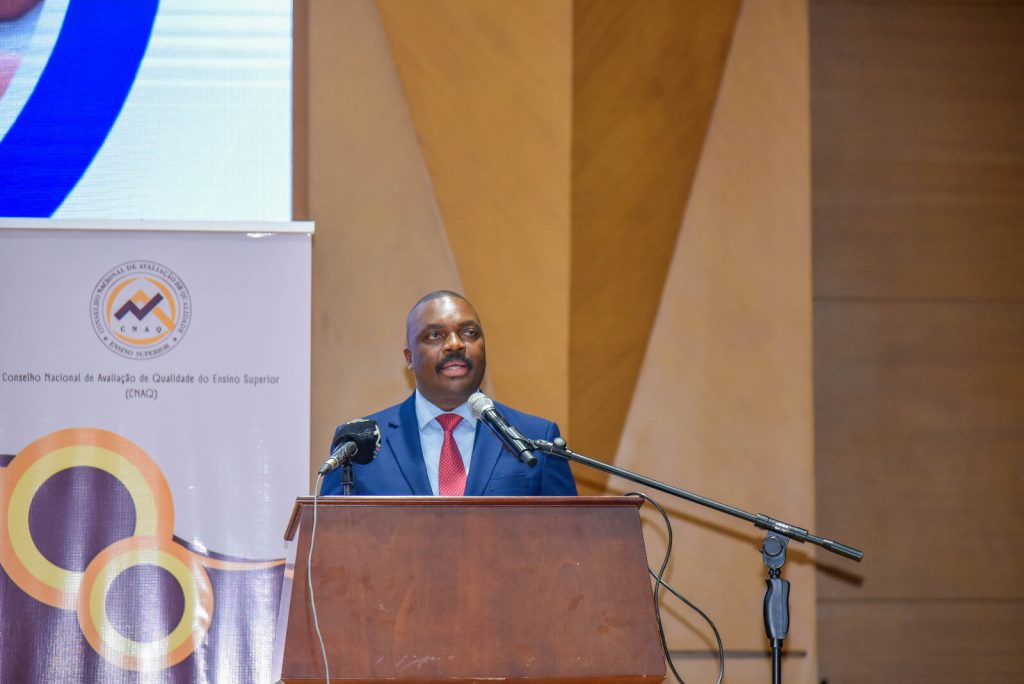
Closing address
It is with great honour that I take the floor at this closing ceremony of the VIII Forum of Higher Education Institution Leaders. Over these three days we have shared experiences, knowledge and visions, debated the ways forward and, above all, reaffirmed our collective commitment to the future of higher education in our country.
I warmly salute all those present for the depth of the debates. The reflections shared are not merely academic; they are a clear roadmap for strengthening the higher education ecosystem.
The role of the Government
The Government’s role, in the context of a social State and a market economy, is clear: to approve laws and public policies, and to create the regulatory, financial and strategic conditions. The Government has a regulating, facilitating and inducing role.
Within this framework, we are preparing the Strategic Plan for Higher Education for the next ten years. We are reflecting on resizing public higher education institutions, with a focus on quality, relevance and employability.
The first scientific research act is in the process of approval and, still this year, we will launch the reflection process for revising the higher education act.
We have signed a memorandum of understanding with the Confederation of Economic Associations. And on this point we need to take a more decisive step, which is to bring the productive sector closer to the universities.
Quality, relevance and employability
The governance of higher education institutions must be focused on quality. Quality is measured in academic excellence, in the soundness of curricula and in the modernisation of laboratories. We must continue to strengthen our assessment and accreditation systems, ensuring that the diploma issued by any of our institutions is a seal of trust and of competence recognised by society and by the national and international market.
More than teaching, we need to teach what the country needs. We need to build productive knowledge. The relevance of teaching is the criterion that validates the existence of our institutions. Our curricula must be stable but not static — that is, they must be dynamic and up to date, respond to our country’s specificities, value our resources and anticipate the needs of our society. A higher education institution is truly relevant if it positively transforms the community in which it is embedded.
The success of a higher education institution is measured not merely by how many students enter or graduate from it, but by the success of the professionals who leave it. Employability is a central priority. We must ensure that our young people finish their courses equipped with the competences — the so-called soft skills — that make them competitive. Youth unemployment is fought with excellent training, with career guidance and with renewed boldness for self-employment.
The triple helix: academia, market and business
The university has its traditional function: teaching, research and outreach. To these, innovation is added today. In this context, the university must not confine itself to its traditional function: it must respond to the challenges of contemporary society, foremost among them employability.
This objective will only be achieved if we accept change and definitively overcome the walls that historically separated classrooms from the productive fabric. The relationship between academia, market and business must be organic, daily and strategic.
The market cannot be seen merely as the final destination of graduates; companies must be active partners in creating courses, hosting internships and funding applied research projects that solve real problems in the productive sector. The relationship between the student and the labour market should not begin after the course ends, nor during the final-year internship, but from the first year.
Training for the present and the future
We are living through an era of accelerated digital, energy, demographic and ecological transition. Our mission is therefore to train for the present and the future, not for the past. We cannot go on training young people merely to ask the State for a job. We must train for adaptability, for critical thinking, for artificial intelligence and for innovation. The future demands citizens capable of learning how to learn throughout their lives.
The role of the university in the face of today’s challenges goes far beyond its traditional vocation. Higher education institutions must be beacons of science and citizenship. In a world marked by climate crises, demographic transitions and disinformation, the university has a moral obligation to lead public debate. It is in the lecture halls and laboratories that solutions must be born for sustainability, social inclusion and our country’s economic resilience.
Public-private partnerships
We are aware that the State Budget cannot cover all the technological and infrastructural modernisation we need. The way forward lies through new bridges: public-private partnerships.
The Government encourages such partnerships for building university campuses and halls of residence, for creating shared technology hubs and for developing clinics and business incubation centres. Together, the public and private sectors can share risks and multiply positive impacts on society.
A paradigm shift
We leave this forum certain that higher education and science are in dedicated, competent and visionary hands. The challenges are immense, but your determination is greater still. Count on the Government to walk alongside you. Together we will continue to build a knowledge and innovation ecosystem that makes the country proud and projects our future.
Universities cannot go on being mere spectators of the future; they must lead. It is with this deep conviction that we call for a paradigm shift in higher education.
The university is, par excellence, the centre of knowledge and the engine of development of any nation. Yet society and the market are dynamic, the world has changed at a dizzying speed, and the way we teach, research and transfer knowledge must also change radically. Transforming education in higher education is no longer a pedagogical option: it is a national imperative, on pain of being reduced to museums.
We cannot go on training twenty-first century young people with twentieth century methods. We need training that is more flexible, more interdisciplinary and connected to the real challenges of our society and our economy. The university must be the laboratory where the future is designed, not the archive where the past is replicated.
Waiting passively for government decrees or public budgets to solve every problem is to abdicate your greatest virtue: intellectual and scientific autonomy. The Government’s role is to approve laws and policies, to support, to create conditions and to define strategic direction, but the dynamism, the boldness, the disruption and the courage to take risks must be born inside higher education institutions — as we had occasion to observe in some institutions already on this path, which we encourage, for they are on the right track.
If the university is the centre of knowledge, then it holds the greatest power of social transformation there is. Let us use that power. Let us dare to reshape curricula, to draw closer to companies and communities, to adopt methodologies that stimulate entrepreneurship, and to create incubators that turn ideas into companies and businesses.
This paradigm shift is not achieved with good laws and public policies alone: it is achieved with leadership, attitude, courage and will. Let us be the agents of the change we seek for our country. The future of our higher education is not waited for: it is built.
With these words, I declare closed the VIII Forum of Higher Education Institution Leaders. Thank you all very much.