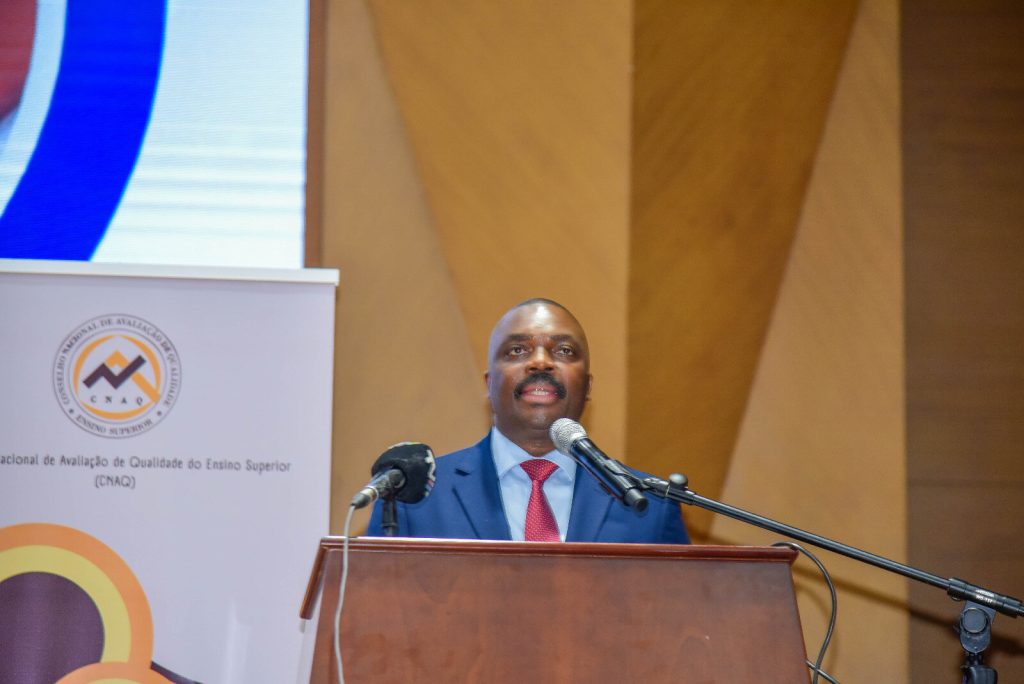
On 12 November 2026, in Maputo, the Minister of Education and Culture, Edson Macuácua, opened the II National Meeting on Vocational Education. In his opening address he argued for technical and vocational education driven by demand, built on competency standards and linked to the private sector through the Confederation of Economic Associations of Mozambique (CTA).
The full text of the speech is published below.
It is a great honour to welcome all those present at the opening of the II National Meeting on Vocational Education. This meeting comes at a crucial moment in our economic history, when we are called upon to chart the paths that will determine self-sufficiency and productivity on the road to economic independence.
The President’s vision for technical and vocational education
Let me begin by recalling the vision of His Excellency Daniel Francisco Chapo, President of the Republic, for Technical and Vocational Education. His Excellency conceives of education not as an expense, but as the safest investment in Mozambique’s economic emancipation. In his vision, Technical and Vocational Education is the mainstay for transforming an economy largely based on services into one that is genuinely productive, industrialised and capable of generating tangible wealth.
This vision points to the strategic importance of Technical and Vocational Education for the country’s development. Mozambique will not achieve sustainable growth without a highly qualified workforce. Technical and Vocational Education is the engine that equips our young people to work in agriculture, industry, fisheries, mineral resources and infrastructure. It is the indispensable link for adding value to our natural resources and anchoring development in our provinces, districts and communities.
From abstract knowledge to knowing how to do
For that transformative force to materialise, we are consolidating a paradigm shift: a technical and vocational education system focused on knowing how to do and on competency standards. Theoretical, abstract training no longer answers the urgencies of our time. Our focus must be on practical skill and technical execution. Every curriculum, every module and every assessment must be framed by rigorous competency standards, so that the graduate of a Mozambican technical school is able to perform with excellence from the first day in the field.
Education driven by demand
To achieve this excellence, we are adopting a Technical and Vocational Education geared to the needs of the market. We reaffirm here the vital importance of technical education driven by the logic of demand. We do not train young people merely to obtain a diploma: we train professionals to fill real gaps in the business fabric.
It is on this basis that the Ministry of Education and Culture has been strengthening and deepening strategic partnerships with the private sector, through the Confederation of Economic Associations of Mozambique (CTA), in order to link vocational training directly to the labour market. The productive sector must dictate what schools teach, so that the training on offer matches real market demand precisely.
Training entrepreneurs
Moreover, faced with the scarcity of jobs in traditional structures, our focus extends to a Technical and Vocational Education that produces entrepreneurs, able to create their own employment. The profile of our graduate must change: our institutions must prepare young people not only to knock on doors in search of a job, but to start their own business, to run small workshops, agro-industries or technology services. By equipping young people with skills in management, resilience and innovation, we are multiplying the centres of job creation at local level and energising micro-entrepreneurship.
The structural challenges
The road to these goals is not free of obstacles. We must face the structural challenges of Technical and Vocational Education head-on. We still face the urgent need to rehabilitate and fully equip our institutes and technical schools, with laboratories and machinery that reproduce today’s industrial reality. Challenges remain in widening access, ensuring that communities in distant regions and students of lesser economic means also benefit from these opportunities.
There is likewise the pressing challenge of the continuous technical and pedagogical training of our teachers, who are the beacon of this process, and the urgency of securing funding for this subsystem of education. Recognising these challenges must not paralyse us; on the contrary, it must sharpen our commitment to designing innovative solutions and to strengthening constructive dialogue with every stakeholder in our society.
The Government, vocational education institutions and the private sector must talk more and sign a pact on a Technical and Vocational Education geared to meeting the needs of the market and of society.
I hope this meeting will be productive, rich in practical proposals and results-oriented, building on the work begun at the I National Meeting on Vocational Education, with the joint design of perspectives and approaches to the various challenges, so as to consolidate Technical and Vocational Education, a strategic subsystem for the country. The young professionals who roll up their sleeves must turn natural resources into wealth, with tangible results that underpin the economic independence we all seek and that bear directly on the lives of young Mozambicans.
With these words, I officially declare open the II National Meeting on Vocational Education.