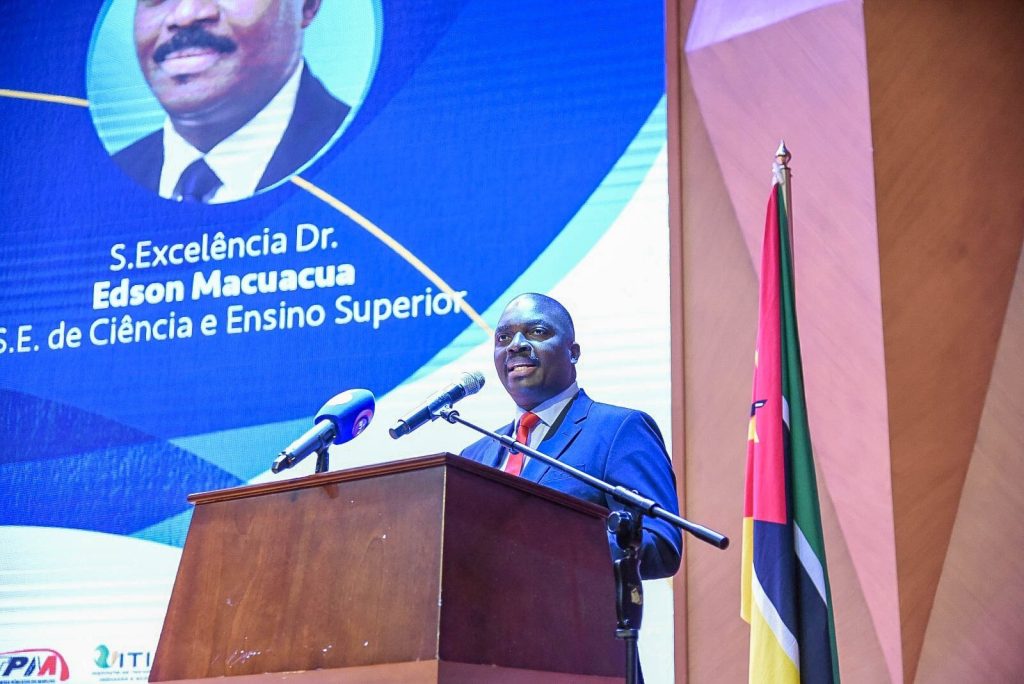
The Secretary of State for Science and Higher Education, Edson da Graça Francisco Macuácua, delivered the opening address at the II University Accounting Olympics, held in Maputo on 28 July 2026 under the theme “Higher Education Priorities in Training Accounting Professionals to Meet the Country’s Development Challenges”.
The full text of the address is published below.
1. Context
If we look at the map of Mozambique today, we do not see only provinces and districts: we see a dynamic economy, driven by major mineral resource projects, sustained by thousands of Small and Medium Enterprises, and challenged by a vast informal sector that yearns for organisation.
Against this backdrop, the question that brings us to these University Olympics is not merely academic. It is a question of economic survival: what priorities should guide higher education in preparing accounting professionals capable of responding to this reality?
For decades, academia taught us to look to the past, to record what has already happened, to issue invoices and close balance sheets. But the Mozambique of today, our organisations and our economy do not need historians of numbers. They need strategists.
We cannot go on training professionals who master the theory of international textbooks but who tremble at completing a VAT or corporate income tax return, or at the practical demands of the Tax Authority’s e-Taxation system. We cannot release into the market graduates who have never operated an ERP system or who cannot read digital data to anticipate the failure of an SME.
The priorities of higher education must change. They must focus on local tax practice, on the digitalisation of the classroom and on direct alignment with the market. It is time to turn accounting into a tool for decision-making and for integrity against fraud.
In this context, the priorities of higher education in Mozambique must focus on curricular updating aligned with international standards, on strengthening technological competence, and on practical connection with the business fabric and the informal sector.
2. Key issues: problem, solution and impact
2.1. The gap between theory, academia and local tax practice
Higher education focuses excessively on universal theoretical concepts, neglecting the complexity of Mozambican reality and legislation, which is in constant flux.
Problem: the newly qualified graduate masters the theory but fails at completing basic obligations such as VAT, corporate and personal income tax, or at using the e-Taxation system.
Solution: universities must simulate the real Mozambican tax cycle in the classroom.
Impact: resolution of tax errors in companies and mitigation of the heavy fines that sink local businesses.
2.2. The urgency of digital transition in the face of organisations’ technological reality
Manual accounting, or accounting limited to Excel, is obsolete given the modernisation of the business fabric and of the State itself.
Problem: the market demands command of ERP systems (such as Primavera, SAP or PHC) and of electronic invoicing, yet many students leave university without ever touching these tools.
Solution: mandatory integration of accounting computer laboratories and an introduction to Data Analytics for auditing.
Impact: the accountant ceases to be a mere processor of invoices and becomes a strategic data analyst for management.
2.3. Adapting to the business fabric: from large industry to the informal sector
Education prepares professionals for large multinationals (such as those in the gas and mining sector), ignoring the greater part of the national economy.
Problem: more than 90% of companies in Mozambique are SMEs or operate in the informal economy, requiring a different management approach.
Solution: teach Management Accounting adapted to micro-businesses and build skills to assist the transition from the informal to the formal sector.
Impact: strengthening of the grassroots economy and greater sustainability of local businesses through rigorous financial management.
2.4. Mandatory alignment with OCAM and professional certification
The degree is no longer the finishing line, but rather the starting point for market regulation.
Problem: lack of articulation between university curricula and the admission examinations of the Order of Accountants and Auditors of Mozambique (OCAM).
Solution: harmonise study plans with OCAM’s internship and examination requirements, allowing a direct transition.
Impact: an immediate rise in the standing of the profession and assurance that new professionals meet the highest ethical and deontological standards against fraud.
3. The profile of the accountant in Mozambique today
The accounting profession in Mozambique is going through a period of profound change. The adoption of the Accounting System for the Business Sector (SCE), of the international public sector accounting standards (IPSAS), and the growing demands of the Mozambique Tax Authority impose the need for a highly qualified professional.
To meet this landscape, the profile of the Mozambican accountant must go beyond technique, encompassing the following essential characteristics:
Analytical and critical thinking: the ability to interpret financial statements and translate figures into strategic insights for business management.
Technological competence and soft skills: the ability to communicate effectively with different stakeholders (shareholders, banks, public administration) and to use advanced digital tools.
4. What model for training accountants in Mozambique?
4.1. Competence-standard-based training
Competence-standard-based training focuses on the practical development of technical skills, analytical abilities and ethical values. This model aligns academia with the real needs of the labour market and of the professional bodies.
Pillars of the competence model
Technical competence: command of accounting standards, taxation, auditing and finance.
Technology and innovation: use of digital tools and adaptation to digital transformation in business.
Ethics and professional conduct: adherence to codes of conduct, integrity and corporate social responsibility.
Curricular structure and methodology
Practical learning: a focus on case studies, real problem-solving and audit simulations.
Performance-based assessment: measurement based on the ability to carry out complex tasks and not merely on memorising concepts.
Professional articulation: partnerships with institutions such as the Order of Accountants and Auditors of Mozambique, the Tax Authority, the Confederation of Economic Associations, the Tax Courts, the Administrative Court and the Court of Auditors.
4.2. Training centred on market demand
The main advantages of training accountants with an eye to the real needs of the Mozambican market include immediate employability, command of local taxation and reduced business risk.
Practical impact and employability
Immediate employability: reduces the mismatch between theory and practice, allowing the newly qualified to take up duties without the need for retraining.
Command of PGC-NIRF and taxation: ensures rigorous application of the Mozambican accounting system (PGC-NIRF) and of national tax law.
Support for SMEs and the informal sector: prepares the professional to work with the country’s dominant business fabric, helping small companies to organise themselves and to leave informality behind.
Value for companies and for the economy
Reduced risk and cost: facilitates rigorous financial control and legal compliance, avoiding fines and disputes with the Tax Authority.
Evolution towards strategic consultancy: turns the accountant into an active business partner in decision-making and in attracting investment, rather than merely a recorder of data.
4.3. Dual training
Dual training for accountants in Mozambique — combining theory at school with immediate practice in companies — is of great importance in responding rapidly to the needs of the labour market. The main strengths of this link are real practice and sound adaptation to local law.
Main advantages of dual training
Practice on the job: the student learns to use real accounting software in the company’s daily work.
Knowledge of the law: they come to understand how Mozambique’s taxes and rules work without losing time.
Easier employment: companies like to hire those who already know how to do the practical work.
Competence-standard-based training for accountants in Mozambique brings crucial advantages, such as alignment with the International Accounting Standards, increased employability, and the strengthening of the technical and ethical regulation promoted by the Order of Accountants and Auditors of Mozambique.
Quality and technical alignment
International standards: ensures that the professional masters global financial reporting rules and local taxation.
Professional rigour: raises the standards of ethics and transparency required by the market and by regulators.
Real practice: focuses learning on what the accountant actually needs to do in the daily life of Mozambican companies.
Employability and recognition
Responsiveness to the market: eases rapid adaptation to the management software employers require.
Investor confidence: increases the credibility of financial reports presented to banks and to the State.
Proactivity and self-directed learning: the degree is only the first step. Students should seek continuing education, specialisation and technological fluency.
Preparing for certification: the importance of preparing for the OCAM examinations in order to enter the profession lawfully.
5. A commitment to Mozambique’s future
Running through the arguments presented, it becomes clear that the future of accounting in Mozambique is not decided in the offices of large companies, but in the lecture halls of our universities.
Changing the priorities of higher education is not an academic choice. It is an economic urgency, a paradigm shift, because we cannot go on demanding that our organisations be competitive and that our economy grow if we continue to deliver to the market professionals equipped with the tools of the last century.
The university of the future must be the laboratory where theory meets the real taxation of our country, where technology is the official language, and where OCAM’s ethics are the shield against corruption. Only then will we turn today’s student into the strategic partner that the Mozambican entrepreneur will need tomorrow in order to survive and prosper.
I close with a reflection. It is often said that accountants tell the story of a nation’s wealth. Well then, let Mozambican higher education change its priorities so that our future professionals do not confine themselves to telling the story of our underdevelopment or our poverty, but are the active architects of our prosperity, our integrity, ethics, transparency, self-esteem, self-confidence and the pride of our Mozambique.
Thank you very much for your attention.