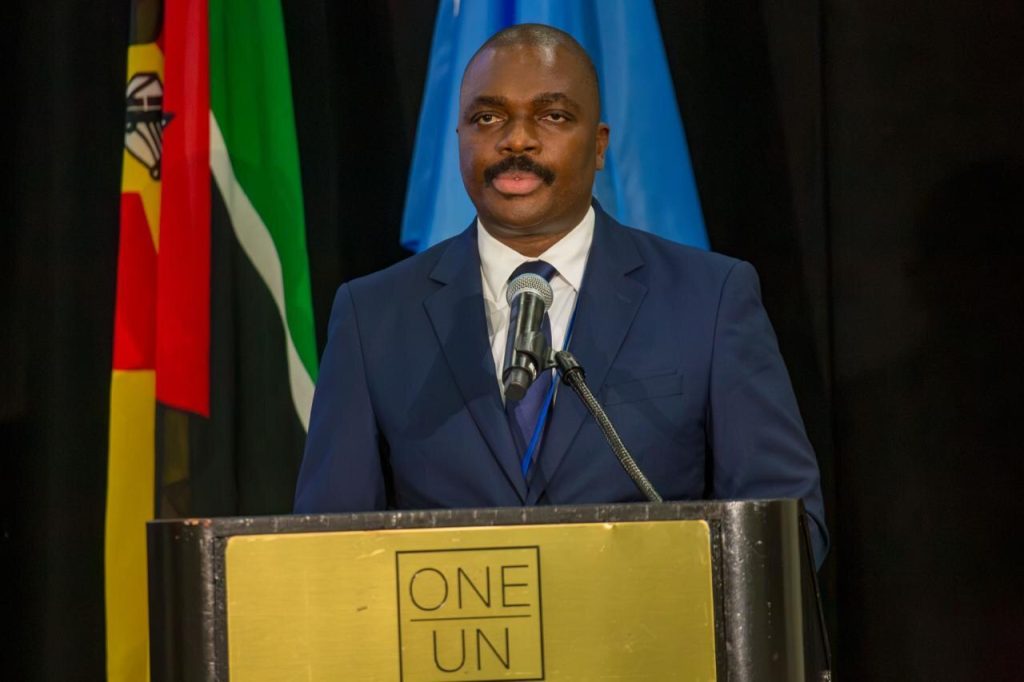
The President of the Technical Commission for the Inclusive National Dialogue, Edson Macuácua, spoke on 23 September 2026 in New York at the high-level meeting “Building Sustainable Peace: The Process of National Inclusive Dialogue in Mozambique”, held alongside the 81st Session of the United Nations General Assembly.
The event was co-organised by the Permanent Mission of Mozambique to the United Nations and by the United Nations Peacebuilding Commission, with the aim of sharing President Daniel Francisco Chapo’s vision and Mozambique’s experience of the Inclusive National Dialogue.
The full text of the address is published below.
Greetings
First of all, allow me to salute His Excellency Daniel Francisco Chapo, President of the Republic of Mozambique, for his strategic vision and leadership, which are delivering the consolidation of peace, national unity and national reconciliation — a public commitment made by President Daniel Francisco Chapo in his inaugural address, at the solemn ceremony of his investiture as President of the Republic of Mozambique.
Allow me humbly to extend my thanks to His Excellency Daniel Francisco Chapo, President of the Republic of Mozambique, for the honour of the opportunity he affords me to take part, and to speak, at this high-level event held alongside the 81st Session of the UN General Assembly, co-organised by the Permanent Mission of Mozambique to the United Nations and by the United Nations Peacebuilding Commission, with the aim of sharing President Daniel Francisco Chapo’s vision and Mozambique’s experience of the Inclusive National Dialogue.
1. Leadership of the Inclusive National Dialogue
The Inclusive National Dialogue is led by His Excellency Daniel Francisco Chapo, President of the Republic, assisted by the leaders of the political parties represented in the Assembly of the Republic, in the Provincial Assemblies and in the Municipal Assemblies, signatories of the commitment to the inclusive national dialogue.
The President of the Republic, Daniel Francisco Chapo, holds quarterly ordinary meetings with the leaders of the political parties that signed the commitment to an inclusive national dialogue — and extraordinary meetings whenever necessary — in order to guide and monitor the process. At these sessions, under the leadership of the President of the Republic, the programme of activities is approved and the process of giving effect to the inclusive national dialogue is regularly assessed.
In parallel, His Excellency Daniel Francisco Chapo, President of the Republic, holds regular dialogue meetings with civil society organisations, the private sector and religious denominations, within his paradigm of government close to the people.
2. Context
The inclusive national dialogue process arises from the deep conviction of President Daniel Francisco Chapo and of the living forces of our nation that political and social crises and structural challenges demand collective and inclusive responses. It is on this basis that the inclusive national dialogue emerges, as a platform for rebuilding the social fabric in a polarised context in which the country, following the elections, was beset by electoral violence that jeopardised public order, security and tranquillity, with a negative impact on the social and economic environment through the loss of human lives and the destruction of public and private infrastructure.
To put an end to this situation, a process of negotiations with different political and social actors was set in motion under the leadership of the President of the Republic, culminating on 5 March 2025 in the signing of a commitment to an inclusive national dialogue by the Government and by all political parties represented in the Assembly of the Republic and in the Provincial and Municipal Assemblies.
3. Legal framework
To ensure that the Inclusive National Dialogue process unfolded with transparency and predictability, and within a regulated framework accepted by all, the Political Commitment to the Inclusive National Dialogue, signed on 5 March 2025, was approved by the Assembly of the Republic in the form of a statute: Law No. 1/2025 of 11 April.
4. Technical architecture
In order to give effect to the Inclusive National Dialogue, a Technical Commission was created by Presidential Decree, made up of 21 members of diverse persuasions — two representatives of each political party signatory to the Commitment and, crucially, three figures drawn from civil society, selected through a public call.
To support the Technical Commission, ten multidisciplinary and multisectoral working groups were formed, composed of representatives of political parties, of ministries, and of citizens of recognised merit selected through a public call, drawn from civil society, academia, the private sector and religious denominations.
For administrative support, a support group was formed of citizens designated by the political parties.
5. Format of the dialogue
In order to ensure greater transparency and to give system and coherence to the Inclusive National Dialogue, a working methodology was adopted by consensus and made public, structuring the dialogue by defining its object, principles, values, organisation, methods, means and the stages of the reforms.
The main stages of the dialogue are:
- Approval of the Political Commitment to an inclusive national dialogue;
- Public consultations in the provinces and in the diaspora;
- Systematisation of the material gathered in the consultations;
- Public hearings to debate reform scenarios;
- Systematisation of contributions and drafting of reform proposals arising from the public hearings;
- Approval of the resulting proposals by the signatories;
- Submission of the proposals by the President of the Republic for deliberation by the Assembly of the Republic.
6. Content of the dialogue
The Dialogue is open to all matters. Citizens are entirely free to raise any political, economic, social or cultural subject. To frame the dialogue, the law sets out thematic strands, namely: Constitutional Affairs, the Justice System, the Electoral System, the Tax System, Defence and Security, Public Administration and the Departisation of the State, Decentralisation and Deconcentration, Natural Resources, Reconciliation and National Unity, and Economic Inclusion.
It is worth noting that the Government has been collaborative and proactive in progressively responding to the various questions raised by citizens within the dialogue, through constitutional, legislative, institutional and public policy measures.
7. What makes the Inclusive National Dialogue distinctive
- It is a presidential initiative, led by the President of the Republic, Daniel Francisco Chapo;
- It is governed by a law defining the organisation, the process and the methodology of public participation;
- It is multilateral, breaking the cycle of political bipolarisation, with the involvement of actors from every quarter of society;
- It is not selective and is not confined to politicians, since it draws on the active involvement of civil society;
- The citizen is an active subject, not presented with a fait accompli but an actor in diagnosing problems and collectively building proposed solutions;
- It is neither elitist nor merely urban: it does not take place only in offices, or behind closed doors in hotels or academic institutions; it takes place throughout the country, covering every province and district, at grassroots level, in communities, including in the diaspora, both in person and online, allowing it to be a faithful reflection of every social, regional and generational sensibility;
- The dialogue sessions are public, and the whole process is followed and publicly scrutinised by political parties, civil society organisations, the media, academics, cooperation partners and ordinary citizens.
8. Guarantees
In order to create an environment of trust among all those taking part, guarantees were approved by law under which political leaders undertook to act in good faith, ensuring that each participant was free to express their opinion and that decisions were taken, as a rule, by consensus.
9. Conclusion
The inclusive national dialogue process, under the leadership of His Excellency Daniel Francisco Chapo, is a genuinely Mozambican initiative, institutionalised as a platform for participation and for the active exercise of citizenship and sovereignty in the service of peace, stability, national reconciliation and cohesion, democracy and the country’s development.
The inclusive national dialogue process has been taken up civically by civil society, which organised public consultation sessions with different target groups according to their fields of activity, putting forward concrete contributions and proposals.
The Inclusive National Dialogue is a work of President Daniel Francisco Chapo’s school of leadership, which raised dialogue to a qualitatively higher level, as a participatory process of collectively building sustainable peace, grounded in his vision that dialogue is not an event but a process; not an end, but a means to building lasting peace, a fundamental condition for economic independence.
Thank you very much.