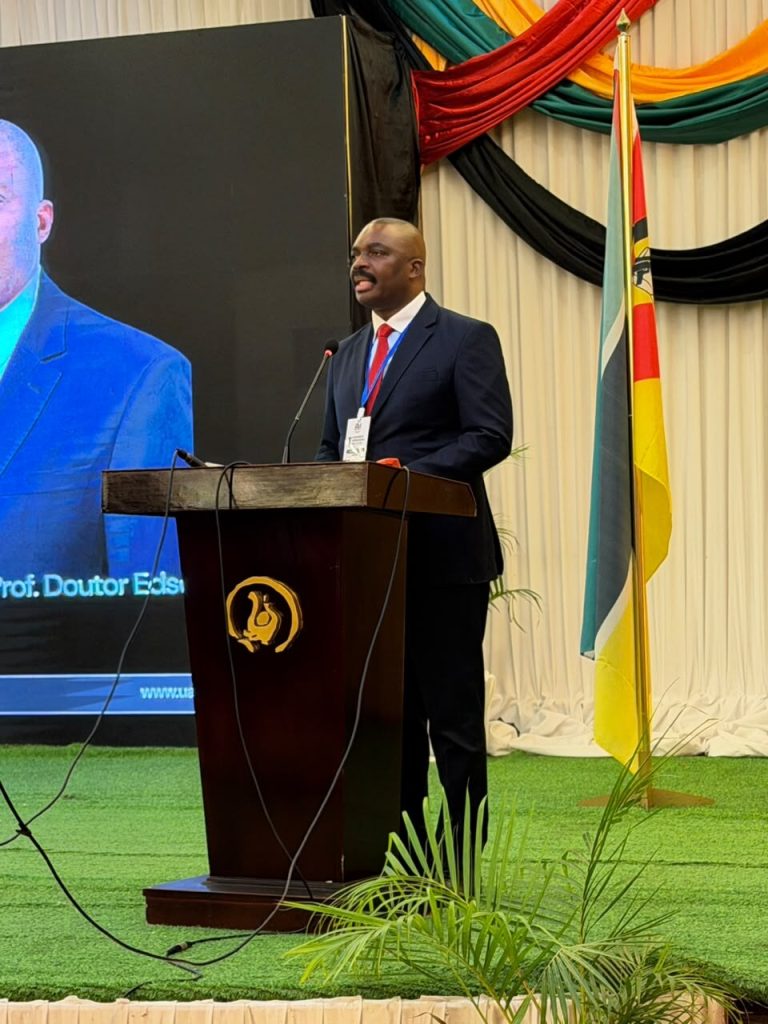
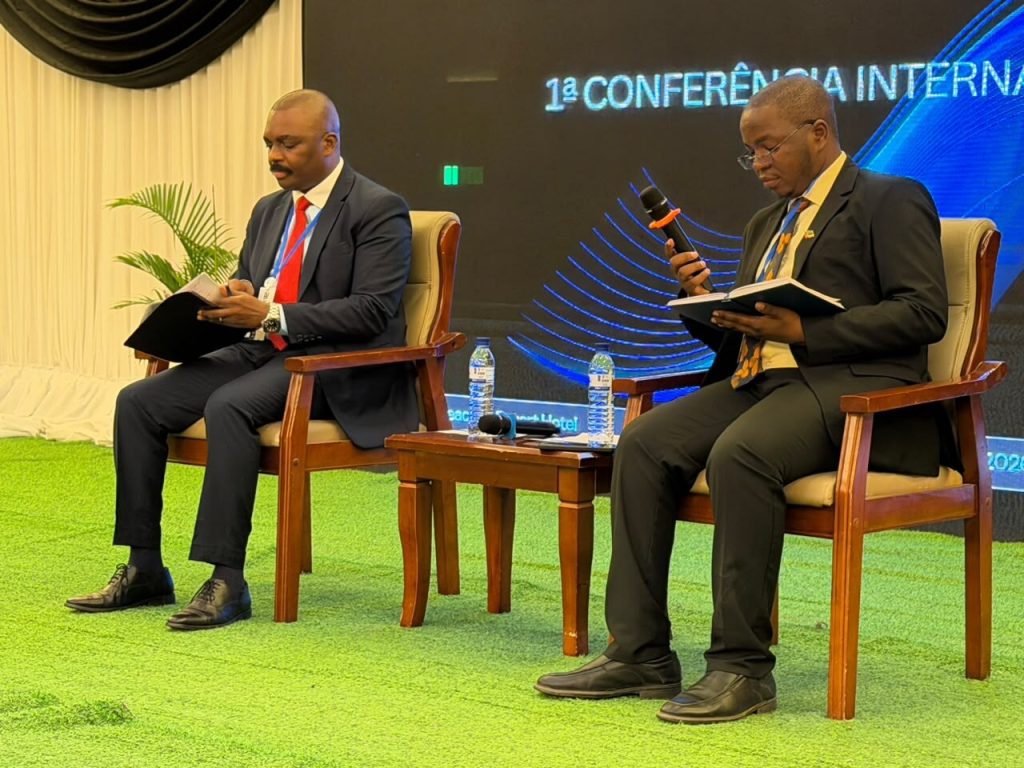
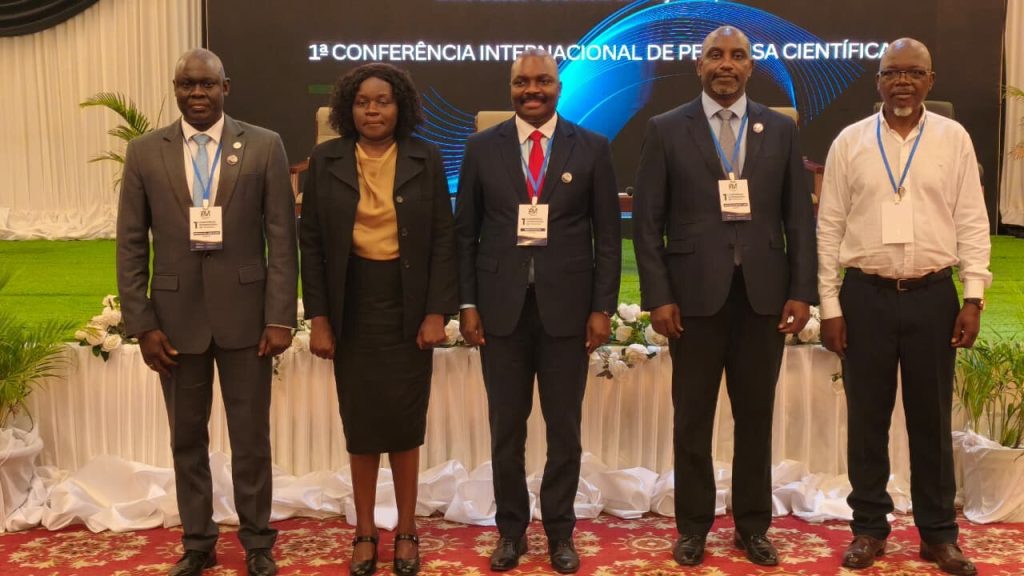
The Secretary of State for Science and Higher Education, Edson da Graça Francisco Macuácua, delivered the inaugural lecture of the 1st International Research Conference of the Adventist University of Mozambique in the city of Beira on 12 October 2026, under the theme “The role of scientific research, innovation and higher education in Mozambique’s sustainable development”.
The session took place on National Teachers’ Day. The full text of the lecture is published below.
Greetings
It is with deep honour and a sense of responsibility that I address you all at this solemn opening session of the 1st International Research Conference organised by the Adventist University of Mozambique.
Congratulations to the Adventist University of Mozambique on organising this International Conference on research, precisely today, 12 October, National Teachers’ Day.
We therefore salute the Mozambican teacher. In science, it is the teacher who kindles the first spark of scientific curiosity; it is the teacher who teaches the method, who awakens critical thinking and who turns the student into a researcher. In higher education, the university lecturer has the twofold and noble mission not only of transmitting accumulated knowledge but also of producing new knowledge through research. And for citizenship, the teacher is the transmitter of the noble values of love, peace, ethics, self-esteem and our Mozambican identity.
We congratulate the Adventist University of Mozambique on its invaluable contribution to training human capital and building a knowledge society. We note with appreciation that it is a university which, over these 15 years of existence, has distinguished itself by its commitment to academic excellence and to the integral formation of the human personality in knowing, knowing how to do, knowing how to be, knowing how to conduct oneself and knowing how to live together. Your focus not only on knowledge but also on the values of love, peace, ethics, integrity and human dignity makes the Adventist University of Mozambique a humanist university.
Congratulations on your contribution to the moral fabric of society, to building a culture of peace and to our country’s sustainable development.
What is the true engine of Mozambique’s future?
Gathering under the theme “The role of scientific research, innovation and higher education in Mozambique’s sustainable development” is not merely an academic act: it is a civic and ethical commitment to the future of our homeland.
We are gathered here not merely to celebrate academia, but to debate the destiny of our nation. We are here to answer a central question: what is the true engine of Mozambique’s future?
The answer is not stored only in the subsoil of our provinces, in the gas basins or in the vast stretches of arable land. The answer lies in the creative, intellectual and scientific capacity of the Mozambican people. The true engine of our development is knowledge.
Today we therefore take on a threefold, inseparable commitment: higher education, scientific research and innovation are the definitive tools for our economic independence.
Thank you to all national and international researchers for your willingness to share the scientific knowledge arising from your work, taking it out of the personal sphere into collective knowledge, a heritage of the nation and of humanity.
Higher education
Higher education in Mozambique has grown significantly in geographical reach and student numbers. Today the university is no longer a privilege of a few in the capital; it is present from the Rovuma to Maputo. Access to higher education is therefore no longer the central question. Our challenge has changed scale: our commitment now is to quality, relevance and employability.
Our academic institutions cannot be mere diploma factories. They must be incubators of critical citizens, ethical leaders and technicians prepared to address the real problems of our communities. We need higher education that engages directly with the needs of the market and with the country’s structural challenges, turning theory into practice.
Scientific research
And how do we turn theory into practice? Through scientific research.
Science is an urgent necessity. To research in Mozambique means finding local solutions to global challenges. It means giving our agriculture resilience in the face of climate change. It means mapping and eradicating endemic diseases that affect our workforce. It means managing our natural resources sustainably and ensuring that the wealth benefits ordinary citizens.
To research is an act of sovereignty. When we produce our own science, we cease to be merely consumers of foreign solutions and become authors of our own destiny.
Higher education and scientific research are the fundamental pillars of our economic independence. Academia cannot be an ivory tower isolated from the reality of our communities. It must be the laboratory where the concrete problems of our daily life are deciphered.
Innovation
Yet science only transforms people’s lives when it becomes innovation.
To innovate is to have the courage to cross the rigour of the laboratory with the boldness of entrepreneurship. Mozambique has a young, vibrant and digitally connected population. We need to create ecosystems that allow this youth to turn ideas into companies, theories into patents and technologies into jobs. Technological and social innovation must be the oxygen that feeds our small and medium enterprises, modernises our public services and cuts red tape in the State.
A nation’s true wealth
Mozambique is a country of immense potential and opportunity, with one of the world’s youngest populations and a wealth of natural resources that draws the world’s gaze. Yet a nation’s true wealth is measured not by what lies beneath its soil, but by the knowledge residing in the minds of its citizens.
In this context, higher education in Mozambique cannot be seen merely as a space for transmitting inherited learning. It must rise as the epicentre of social and economic transformation. Our greatest challenge is not merely to produce graduates, masters and doctors; it is to shape critical thinkers, ethical leaders and agents of change capable of responding to the challenges of poverty, climate change and the need to diversify our economy.
Education without research risks becoming obsolete. Scientific research is the beacon lighting the path to development. In Mozambique we need a science that does not speak only to international peers in restricted-access journals, but that speaks, fundamentally, to local communities, building productive knowledge.
We need applied scientific research that develops solutions applicable to the problems affecting communities, that optimises the management of our natural resources, and that proposes effective public policy grounded in scientific evidence, in the service of citizens’ well-being.
Science, however, only translates into social well-being when it takes the next step: the step of innovation. To innovate, in our context, does not necessarily mean creating inaccessible cutting-edge technologies. It means finding new, efficient and sustainable ways of solving old problems. It means connecting Mozambican traditional knowledge to the rigour of modern science. It means, above all, creating ecosystems where universities and the productive sector actively collaborate, turning academic work into companies and research projects into solutions for the market.
Innovation is the blood running through the veins of development; it turns theoretical knowledge into jobs, into new companies and into more efficient public services.
We therefore salute the Adventist University of Mozambique on the inauguration, yesterday, 11 October, of its innovation and business incubator — an effort through which young people will have the opportunity to learn to turn ideas into companies and viable businesses and to create jobs, moving from the culture of “I look for a job” to the culture of “I create value”.
A choice, not an accident
Sustainable development is not a destination reached by accident. It is a choice made through strategic investment and long-term political vision. No Agenda 2030 or Agenda 2063 will be fulfilled in Mozambique without a strong, proactive scientific community.
To improve the scientific research ecosystem, the Government is preparing the draft scientific research act, for better regulation. The 1st National Conference on Scientific Research is also in preparation, aimed at driving scientific research forward and optimising the work and coordination of higher education institutions and of research institutions, both autonomous and those overseen by different ministries.
To our academics and researchers I leave a word of deep admiration: continue to research, to question, to discover and to create, for scientific work is the beacon of our nation.
Let us walk together, with the boldness of innovation, the rigour of science and an unshakeable commitment to the well-being of every Mozambican.
Congratulations to the organisers of this 1st International Research Conference, most particularly to the Rector of the Adventist University of Mozambique, to the university’s collegiate bodies, to the teaching, student and technical-administrative staff, to the speakers, moderators and all participants.
Thank you all for your attention.