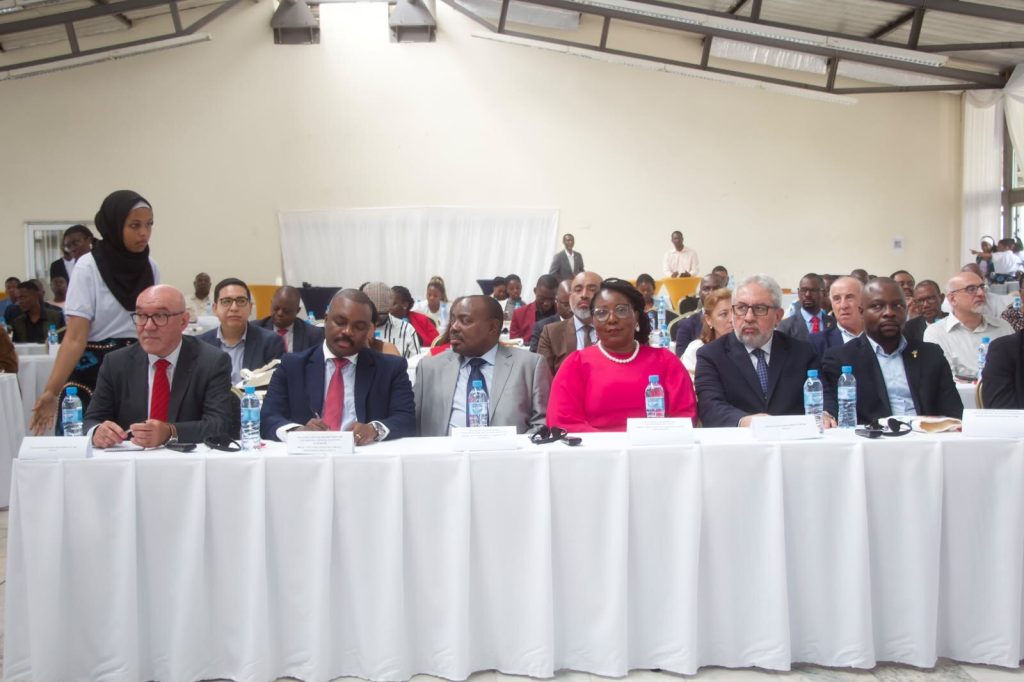
On 9 November 2026, at Ponta de Ouro in Maputo province, the Minister of Education and Culture, Edson Macuácua, opened the 1st National Meeting of Education and Culture Inspectors. In his opening address he called for a shift from bureaucratic inspection to inspection based on proximity, and declared zero tolerance for the sale of grades, illicit charges, sexual harassment and the misappropriation of funds in the sector.
The full text of the speech is published below.
It is with a deep sense of responsibility that I take the floor at this opening session of the National Meeting of Education and Culture Inspectors. This meeting comes at a crucial moment, as we commit ourselves to revitalising our National Education System, turning the school into a genuine hub of development and of Mozambique’s emancipation towards economic independence.
As His Excellency Daniel Francisco Chapo, President of the Republic, has said, education is not an expense: it is a strategic investment and a critical factor in our nation’s agenda of development and economic independence. And for that investment to bear the fruit the Mozambican people deserve, we need a strong, active and reinvigorated inspectorate.
The role and importance of inspection in education and culture
Inspection in education and culture must not be seen as a merely decorative body, nor as a punitive one or a matter of cold enforcement. Inspection guarantees compliance with public policy in education and culture, and is the chief barometer of the health of our education system and of the country’s cultural development.
The current challenges facing education inspection
We recognise that the challenges facing inspection are immense and complex. We work in a context of limited material, financial and logistical resources. We face the challenge of covering every school, some of them hard to reach because of distance, transport and road conditions, as well as the challenge of monitoring the implementation of public policy in the culture sector.
The dynamism of society demands the modernisation of inspection in education and culture. The great challenge today is to move from a merely bureaucratic inspectorate to one based on proximity, able to engage in dialogue, to interact and to understand local realities. We must overcome the shortage of means through creativity, by thinking outside the box, by rigorous strategic planning and by the intelligent use of new information technologies, so as to maximise the impact of our work.
Why inspection based on proximity is critical
In response to the challenge laid down by His Excellency Daniel Francisco Chapo, President of the Republic, that we adopt leadership based on proximity, we wish to give a clear instruction: the Inspector’s place is in the school and alongside the community. We cannot have an inspectorate built on office reports.
The Inspector’s physical presence in the school is essential. It is in the school that the Inspector observes the attendance of teachers and pupils, the state of the infrastructure, the care and distribution of textbooks and, above all, the effectiveness of teaching and learning. Our presence in schools must be an act of support and institutional dialogue. We must engage with and listen to head teachers, teachers, school councils, and parents and guardians. It is in the field that real problems and challenges become known and that concrete solutions are built.
Inspection as a guarantee of ethics, integrity and the fight against corruption
The school must be the guardian of moral values, of ethics and of citizenship. Inspection in education and culture therefore bears a patriotic responsibility for safeguarding integrity and for the firm fight against every form of corruption in the sector.
We declare zero tolerance for the sale of grades, for illicit charges at enrolment or examinations, for sexual harassment, for unjustified absenteeism and for the misappropriation of funds or goods intended for the school community. Inspection must act with firmness, impartiality and integrity. Those who oversee must be the first example of integrity. We require of inspectors an exemplary ethical stance, so that we may purge from our system any conduct that calls into question the dignity of the noble profession of teaching and the future of our country.
Educational inspection and the guarantee of teaching quality
We wish to underline the school’s mission: to ensure that the school teaches knowing, knowing how to be, knowing how to conduct oneself and knowing how to do — and not merely knowing how to speak. We cannot have a school that prepares people only to speak well. Inspection must take the side of this goal: that the school be a place of learning. The school cannot confine itself to producing citizens capable only of memorising content; it must form young people able to transform the country’s economic and social reality.
Educational inspection is key to guaranteeing the quality of teaching in Mozambique. By assessing pedagogical practice, by ensuring that school time is respected and by requiring scrupulous compliance with the curriculum, Inspectors raise learning outcomes. The quality of teaching is not an abstract goal: it is built in the classroom, by ensuring that children genuinely learn to read, to write, to count and to think critically, at the right age.
We hope this first meeting of education and culture inspectors will be crowned with success and will be an important moment of exchange of experience and sharing of knowledge, towards harmonising and refining working methods, for the continuous improvement of the quality of teaching and learning and for the development of culture.
With these words, I have the great honour of declaring open the First Meeting of Education and Culture Inspectors.